
Become Consciously Aware
Of how small we are
Boozhoo, indinawemaaganidog! Aaniin! That is to say hello, all of my relatives! Welcome to another edition of An Irritable Métis. This newsletter began as a couple ideas I wanted to share on Earth Day but, obviously, failed. The ideas have since expanded and multiplied and wrapping my arms around them is probably more than I can accomplish in the near enough future; the result of this frustrated mental wrangling is what you will read here should you choose to proceed. What I’ve tried to do is break each idea up into its own relatively brief section with a question that so-motivated readers might be willing to answer in the comments. A conversation would be cool, I think, rather than just my incessant bloviating.
As always I appreciate your time. I’ve been mentioning that I started a “buy me a coffee” thing for those of you compelled not to subsidize Substack and it seems there are quite a few of you. Based on a couple emails I’ve received, it also seems there is some confusion about it. Here is the gist of a response to one of those emails inquiring after my preferences toward how best to flex that generous support:
I’m happy to take financial support either way. Ultimately I intend to get off Substack and have my newsletter delivered outside of the confines of their platform, which is growing more and more enshittified and causes many folks consternation, justifiably, for their profiting off the more reprehensible elements of society. I’d like to divorce from that as well, I just haven’t figured out a plan yet but it’s something I’m moving toward in the next year.
If pressed to choose today, I prefer paid subscriptions through Buy Me a Coffee but I’m still fine with payment through Substack as well. I don’t know which way is easier from a reader’s standpoint and I urge folks to consider that first. I’m grateful either way.
I hope this makes things a little clearer for those of you scratching your heads. My migration elsewhere is in no way imminent, I’d just like to pull it off in the next few months while also knowing how quickly that time will pass and how slowly I make changes. Writing here, inconsistent as it is, remains a wonderful means for interacting with readers in a manner more “authentic” and grounded than work that goes through multiple layers of editorial input (and therefore all too often has the life sucked entirely out of it) and I enjoy it very much … so it’s in no danger of disappearing entirely.
Oh, one more thing: about those direct emails. As part of my disentangling efforts I moved the email I use for Substack to a different email address. That seems to have broken some of the “functionality” here, particularly as it relates to the internal messaging part of this buggy hellscape, which I never used (or even asked for, see the above link to enshittification) anyway. So if you’ve tried to message me through Substack in the past couple months or even longer, I haven’t seen it and that’s a bad way to reach me anyhow. Instead, you may reply to the emails that come when I post a newsletter; you should know that though I read most of them I don’t often respond. If you really need to reach me, the Contact page on my actual website gives the best information. Finally, when I’m on the road I don’t do much correspondence and sometimes it piles up so badly that for mental peace I will often delete it en masse and unread on my return. It’s just a lot to keep up with and it makes me crazy. As a result of that, I sometimes delete stuff I shouldn’t have. If it’s important, just be persistent and, most importantly, don’t be in a hurry.
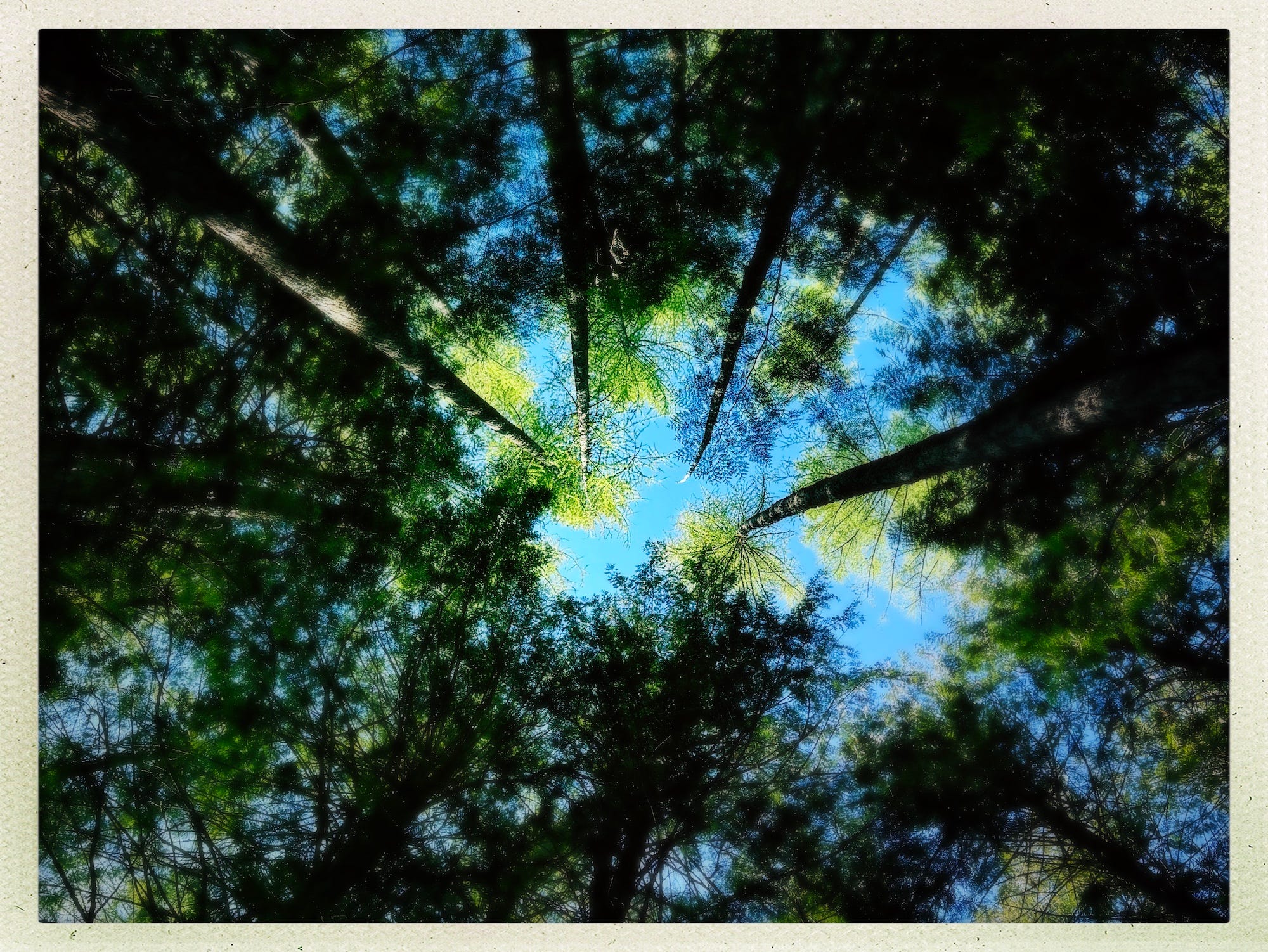
“Don’t be in a hurry.” What a perfect (and unplanned!) segue from the introduction to this section. Because let me tell you: there are few things I hate more than being in a hurry. I prefer to leave early for things and arrive early, even if – especially if – it means lingering somewhere an extra twenty minutes just to chill or fortify myself for whatever it is I’ve arrived to do. This tendency has only been exacerbated by these last few years of extreme busyness I’ve been engaged in, to a degree that I’ve felt largely separated from who I am and who I want to be and I don’t like how that sits with me. It has felt like a constant state of hurry from one thing to the next, a hurry back to wherever I’m staying to catch up on work, hurrying through it so I can find time to rest and get up and start all over again, all with a growing accumulation of stress riding along. This isn’t exclusive to me. I bet the majority of people reading this experience life similarly. I’m fairly certain everyone I know does.
So here’s the first question: how do you defy the speed of modern existence? Do you? Do you have routines to keep you grounded and connected to a solid idea of what you want your life to be?
My most critical grounding connection has always been efforts I make to get out on the land and that has been difficult to make time for than it should be. Lately whenever I’m home for a few days or even a blessed week or more, the most critical time of day for me is first thing in the morning when I take to the porch. That used to be writing and journaling time but those efforts have taken a backseat to just being out there. I leave my coffee and my notebook next to my chair and the first thing I do is set out on a short saunter to determine what is what and who is around that day. I’ve recently re-read Ted Kooser’s wonderful Winter Morning Walks and was reminded of the tradition I’m a part of in making these little jaunts and it never fails to bring joy. There is so much going on out in the world that we miss when we are tied to the indoors, tied to hitting the ground running to manage task lists, etc. Sometimes those tasks are unavoidable but I do my best to schedule my days so that first hour or so remains devoted to beginning the day in slowness and a degree of stillness. I’m better for the effort.
“I think when you try to slow down in our society, it’s kind of rebellious.”
– The Functional Melancholic
I stumbled across this guy who calls himself The Functional Melancholic on YouTube some time ago and I enjoy what he says and how says it very much. I watched a recent video of his called “While Doing Nothing Feels Illegal Now” over the days I’ve been pecking away at this edition of my newsletter. He opens the episode by saying, “So the other day, I tried doing absolutely nothing” and riffs from there. I think Irritable Readers who can spare 40 minutes or so might enjoy the experience.
“Nothing can be more useful to a man than a determination not to be hurried.” – Henry David Thoreau, from his Journal, 22 March 1842
I couple months ago PBS debuted a three-hour, three-part documentary on Henry David Thoreau. I was on the road somewhere when the excerpt above crossed my path and, enjoying that, I decided I would fain watch the first episode. I did, and loved it. The second episode highlighted the Walden Pond years and I figured that would be the high point for me. I was wrong; I think I liked the third episode the best. I urge anyone with even a passing interest to give the series a shot.
Thoreau’s Walden was for me, as it was for so many people, a foundational book. At the time I read it – in my late teens/early twenties or so – it wasn’t like anything else I’d ever encountered. I read it again a handful of years after that and loved it even more. As I grew older though, I grew weary of how commonly the guy is quoted. I judged him by how I felt about people who talked about him, or the shitty products that traded on his words. I think I got a little smug in my attitude and bought into so many of the arguments his naysayers like to level at him, primarily that he really wasn’t even close to actually living “out in the wilderness” as he allegedly claimed to be. Recently I tried to revisit Walden by listening to it and abandoned it. I thought about surrendering my benchwarmer seat on Team Thoreau club to someone else.
The documentary arrived at a time I was really questioning many attitudes I’ve been carrying, primarily as it relates to what we might call “nature writing.” When I was in Minneapolis last fall for Milkweed’s Booklovers’ Ball, during her keynote Robin Wall Kimmerer spoke about nature writing. I wish I had the transcript of her words. But it got me thinking about nature writing, the impact and importance it’s had on my life, and of so many other people’s lives. It’s a place where the stories we need to inspire people to change the world we’re in live, at least for people like me.
And outside of RWK, there are essentially no Indigenous people being published in the genre. Sure, you can point to a writer here and there but the genre is overwhelmingly white and male, though the stranglehold those dudes have had on the theme is loosening. As I’ve considered the ideas I have for my next book, I realized I would really like to have a foot in that genre myself, standing in this case on the shoulders of titans like Robin. Indigenous voices are needed in these kinds of books, at conferences and on panels and everywhere these perilous times demand discussion. There is no future without our voices.
So I’ve had to find a level of acceptance, as I so often do, of the world we’re in vs. the world as I would like it to be.1 Part of that acceptance is the fact that there are a lot of good ideas in the writing of non-Native people right beside their all-to-common erasure of Native people while expressing that work. I can learn from those people and add to the conversation by practicing a degree of acceptance … as well as courage in opposition to the erasure. I have to swallow my indignation (and irritability) and get out of my own way more, and it isn’t easy. I believe our collective future is an Intertribal one, one of many voices, of many more seats at every table for all the until now unrepresented perspectives. There’s no time to waste either.
You know who does a mighty job of everything I’m talking about? Drew freakin’ Lanham, featured in the following video, who I am stoked to finally get to meet in person next week.
So here’s another question: what is something you’ve had to accept, to get out of your own way, in your efforts to pursue the things important to you? Or even books or writers you’ve had to engage with that while problematic in some ways, still have something to teach you?
As for Thoreau, watching the documentary rekindled my regard and interest in the guy in ways that, for example, the Jim Harrison biography did not (though Goddard’s book is excellent). Thoreau was complicated and full of contradictions but also curious and interesting and has left a mighty legacy. There is much yet for me to learn there, I think. I don’t believe he should be put on the pedestal so many folks hoist him up onto though, and I don’t think he’d disagree with me on that. No one should be on a pedestal. He’d agree with that too.
Song of the Seasons
So much of what I’m wrestling with and thinking about here – slowing down, stillness, paying attention, nature writing – is about connection to and relationship with the older than human world. Emergence Magazine put out a little book called Song of the Seasons: A Meditation on Cycles, Story, and Humility written by founder and executive editor Emmanuel Vaughan-Lee. It’s a one-sitting read and I really enjoyed it. Vaughan-Lee writes:
“With humility we can walk through a forest in silence, attentive to simple ways of being that bring us into a space of presence, and become consciously aware of how small we are. This humility offers a container. If in that smallness we can say, teach me how to be humble in this wondrous moment — that might allow us to not get caught in the hubris of saying, I have been opened and now I want to go on a journey and I want to have an experience and be nourished by this forest. When we make the experience about ourselves we are no longer present, humble, nor in relationship, no longer open enough to receive what is really there. We can take in the most immediate gifts of a forest – the oxygen, its beauty and calm – and that can nourish us and it does nourish us. But that is like looking at a tree and seeing only its leaves, the most visible layer, while missing the deeper structure: the branches, the trunk, the roots. The Earth gives on many levels.”
I love that, especially the essential recognition that we are small, that we are tiny little specks in a vast system of relationships. So important and so blasted easy to forget while we blunder around as the presumed main characters in every bit of the story swirling around us. What an important thing to be reminded of over and over again!
Additionally, the bold part is something I highlighted because I relate to it big time. I like my porch sits because when I’m out there I’m not asking for anything, I’m just feeling part of what is happening around me. Sometimes it’s calm and quiet and some folks might wonder what the big deal is but I love it just the same. Other times I happen to be in the right place at the right time for something wondrous and I love that too. That kind of slowing down, of “being there”, is what Thoreau advocated for and what I connected to in the first place and that is also so easy to forget about the importance of.
When I’m not slowing down, when I’m not making time for stillness, I am not at my most open to the world. With openness comes risk though, so there’s that … but what is life without risk?
“I think when you try to slow down in our society, it’s kind of rebellious.”
– The Functional Melancholic
Last question: what’s an experience you’ve had that you’d have missed if you’d just been go-go-going, when slowness or stillness put you in the right place at the right time?
And Finally….
I had a couple important class announcements/reminders and a couple other things I intended to share but this newsletter is too long already. I’m going to follow up in a couple days with one dedicated specifically to announcements, so stay tuned….
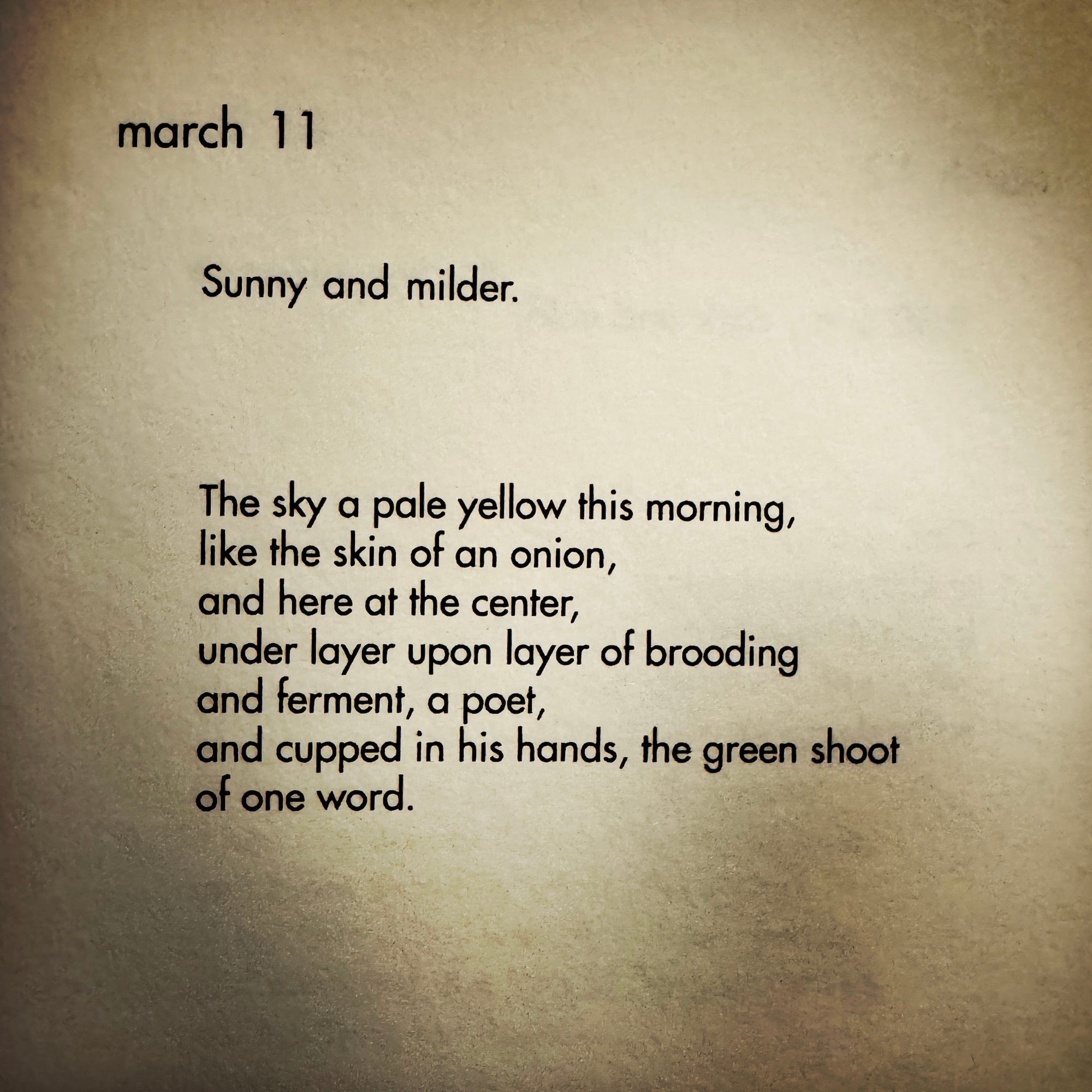
Meanwhile, here’s a lovely little poem from the Ted Kooser book I mentioned:
Miigwech for your attention, friends. I’m grateful you are here.
I don’t think I need to say this but I’m going to anyway: there are some structures and ideas and people expressing them that are not acceptable and shouldn’t be. There are a lot of despicable people who need to be challenged at every opportunity. Those aren’t the people I’m talking about.
“the speed of modern existence”: that phrase arrestingly (literally, stopped-me-in-my-tracks) reminded me of something I’ve been noticing recently in a specific setting: automated self-checkout machines. They are constantly nagging and hustling you along at a mechanical, one-size-fits-all pace, in that 1950s authoritarian librarian voice they inexplicably persist in using that makes you visualize Betty Crocker in an apron with a bullwhip. I notice it because I’m getting old and becoming that person ahead of you in line who’s maddeningly fumbling with cards and change. But what is the effect on young people of being subjected to this impersonal move along, move along? It tells your very cells that you are an interchangeable unit on a consumption assembly line which produces more profit the faster it runs. Like preparation for robots doing all the shopping.
Do less. Live with less. Allow boredom. Grow shit. Take lots of naps. Say no.