
Time is Like Sparks
Knocked off flint
Boozhoo, indinawemaaganidog! Aaniin! That is to say hello, all of my relatives! Welcome to another edition of An Irritable Métis. This might be the shortest introduction in the history of this newsletter because I’m going to get straight to it without any of my typical preliminary blathering. I appreciate you reading!1
I know it’s short notice, but the primary purpose of today’s newsletter is to draw your attention to an hour-long discussion I am participating in this coming Sunday, July 26 at 5 pm Pacific/6 pm Mountain/7 pm Central/8 pm Eastern. It is another Chickadee joint called PERCH, which is kind of a quasi-book club thing that culminates in a zoom discussion with the writer of the book. So I hope you will consider spending an hour with me, Anna from Chickadee, and the writer Terria Smith, in support of her first book, I Love You So Many: A Native Memoir of Adventure, Culture, and Family, who I did an in-person conversation with once already for her release event in Oakland, CA. She’s a lot of fun and I’d like her to feel welcomed by a (Zoom) room full of people.
There is more information HERE about this month’s event, which also happens to mark the PERCH debut2, as well as a link to sign up to attend. The sign-up link is a donation request (which has been updated to $5 - $30) that unfortunately makes you pay at least $1, which is a failure of these capitalistic systems, because it won’t let us provide a free option.
If you want to attend and don’t want to donate, or are curious and want to attend before making any kind of financial commitment, just respond to this email and I’ll make sure you get the link to attend for free.3
As I’ve said, I care more about people showing up than I do raising money. In case you’re wondering about the book, the following are details from the Bookshop.org page for I Love You So Many:
Growing up on the Torres Martinez Reservation in Southern California, Terria Smith longed for adventure. She became a journalist, hitting the road and reporting on the rich lives of Native people around the United States. As her hunger for travel grew, so did her understanding of community, and what it means to be a world citizen today. I Love You So Many–named after a favorite expression of her Spanish-speaking relatives–follows Smith from her ancestral homelands to Cuba, Iceland, Guyana, and back again. With exuberant, laugh-out-loud style she tells stories about forging profound friendships, falling in and out of love, and celebrating the determination that carried her through hard and heady times alike. She brings a fresh sensibility to travel writing, building enduring relationships with the people and cultures she visits. For Smith, travel is deeply rooted in Native traditions: It’s about sharing, reciprocity, risk-taking, and the valuable (and sometimes awkward) work of bridging and holding differences. As fun as it is poignant, I Love You So Many is an irresistible tribute to getting out and living a life in full.
What I like best about this book is it isn’t anything like “typical” or “expected” Native memoir. That is something we will certainly get into! It’s going to be a good time.
Now I want to talk about why this is happening in the first place. One thing I enjoy is facilitating discussions. If you’ve ever taken any of my classes, live or in person, you know they are more about sharing ideas than telling anyone how they should be doing anything. I like getting people involved in expressing themselves, in telling their stories. I don’t care about helping create more poets or writers or any of that. I want more people sharing their lives because that is where we find connection and create community, something I’m awful at myself.
My role in the PERCH enterprise is based in this. I like to participate in these types of things and, critically and crucially to Chickadee’s education-based mandate, I like to think we can raise awareness to books by Native writers you might not otherwise hear about. The books are one thing; what is important is books are written by people, and by attending one of these events I am hoping you will learn more about the Native experience through the interaction with someone living their version of it. Non-native creative types have gotten opportunities and attention far beyond what our Indigenous relatives have had to tell their stories. That is changing, if slowly. I’d like to think an effort like PERCH is contributing to this re-balancing. So please, respond to this newsletter if you want in, or click over HERE and enroll. I’d love for Terria to feel welcomed by this community.
“But La Tray, it seems like you are always asking us for money.”
– Everyone
Do I ever feel that. Most of my posts here4 begin and end with an extension of the digital begging bowl while I mewl for financial support. It’s tiresome to me too, this constant groveling for money. Then there’s stuff like IPFEST, which feels like a nonstop fundraising effort for two freakin’ years straight. It’s exhausting and difficult and does nothing to make me improve myself as a person and has me constantly second-guessing whether it’s coming close to achieving anything meaningful. And now here I am talking about PERCH and pointing out an opportunity for you to participate via optional donation. When does it end?!
For many things it can’t end, and here’s why this is one of them. The first order of business is to pay the guest writer. That’s happening whether enough money for it is donated or not. Writers don’t typically get paid for book events. We want to be one place where they do. One might suggest that royalties for books sold might make up the difference but that is also rarely the case. I was fortunate to have earned out my advance with Becoming Little Shell very quickly so I get royalties. I don’t recall the specific percentages, but now that it’s in paperback, I’d have to sell somewhere between 100 - 150 copies to match via royalties what we are paying our guests for a single one-hour appearance. That isn’t too suggest we are paying a ton, it’s a commentary on the meager nature of book royalties and book sales. My first ever royalty check was decent. My second, not so much. My third, even less. The next one I get, in January, will not likely break three figures given how old my book already is and my fading moments of my fifteen minutes of fame.
We take paying people seriously. None of the guests for any of this stuff go unpaid (unless they request to defer, which happens now and then). Artists get paid for the graphics they provide to give these projects a little sizzle … like, in the case of PERCH, Lindy Racine, who provided the image of a chickadee perched on a branch. Then there are the costs related to zoom accounts, web hosting, website maintenance, etc. Good ideas don’t guarantee giant behind-the-scenes donors or foundations propping them up, especially for Native-facing endeavors. Every project is a new funding effort beginning at ground zero. So whatever extra money that comes in for a PERCH event, for example, goes right back into the churn of funding for the next one. So every dollar truly makes a big difference. Or creates the space for someone to attend who can’t afford it, which is important too. Money will never be a barrier to attendance on any of these things.
This seems a good time to talk about my attitude when it comes to paid subscribers here at this newsletter too, since I’m on a freakin’ roll. Years ago I had a brief period where some content was available only for people who paid for it. I scrapped that pretty quickly. I fundamentally disagree with the notion that people with money should have a different experience than people who don’t. My feeling is if what I do here is of value or interest to you, and you can afford to, you should pay. Or at least be paying to your available budget for other people, even if I’m not one of them. It often feels like we are all passing around the same collection of $50 bills to each other anyway, the most generosity coming from those least able to afford it.
I’ve been saying for years that this newsletter funding model, besmirched as it is by the shenanigans of Substack as a product developed by tech ghouls, is a loose form of mutual aid. People who can pay, should. People who can’t pay shouldn’t be denied access. Money isn’t real and it doesn’t belong to anyone anyway. It’s just an agreed on nightmare that we’ve all decided to allow ourselves to be shackled to and it sucks. We’re tired little ants scrambling around to avoid the murderous beams of concentrated light from the magnifying glasses held by the tiny billionaire (and more) class. It’s awful. But maybe we can be interesting each other now and then along the way.
And Finally….
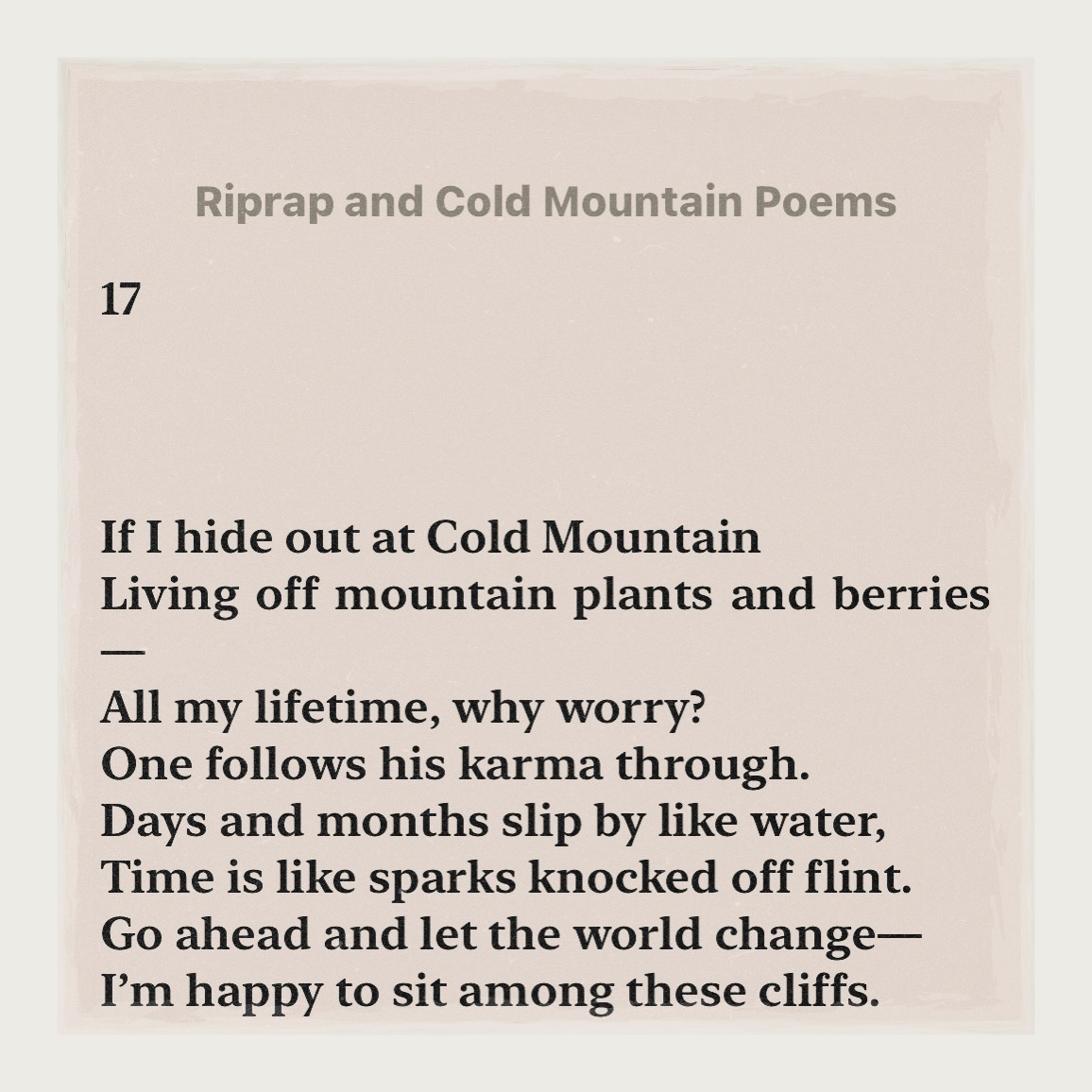
This is one of Gary Snyder’s5 translations of Han Shan. I love it. I’m tired of conflict and change and mistake-making and everything else and I often reflect how I’d be chuffed to join the old poet on those cliffs, even if it’s a ridge or two removed.
I’m grateful, as always, for your support. I’m tired and crabby tonight but that doesn’t make me any less appreciative of the gift of your time and attention.
This is the first footnote but it should be the last because I wrote it last. I finished the newsletter, scrolled back to the top to proofread it one more time, and said to hell with it, I’m just going to post it. Apologies for any typos or irrational contradictions you might encounter along the way.
In retrospect I think we’d have been much smarter to wait another month, given how busy July has been, but enthusiasm for shiny new objects is a stout opponent.
If you decide to donate during or after, you will be able to do that, but again, it’s not required.
Not this one though. NOT THIS ONE!
I’ve been reading a bit of Snyder here and there lately. I’ve come to the conclusion that he is going on the same shelf as Walt Whitman: I like the idea of the guy far better than (most of) the work.
Love this one sentence! "Money isn’t real and it doesn’t belong to anyone anyway. It’s just an agreed on nightmare that we’ve all decided to allow ourselves to be shackled to and it sucks. We’re tired little ants scrambling around to avoid the murderous beams of concentrated light from the magnifying glasses held by the tiny billionaire (and more) class."
A great amount of gratitude swells my heart, knowing you for many years now, supporting your newsletter, reading you within each writing.